
High-Density Ore Machine Upgrades
Challenge
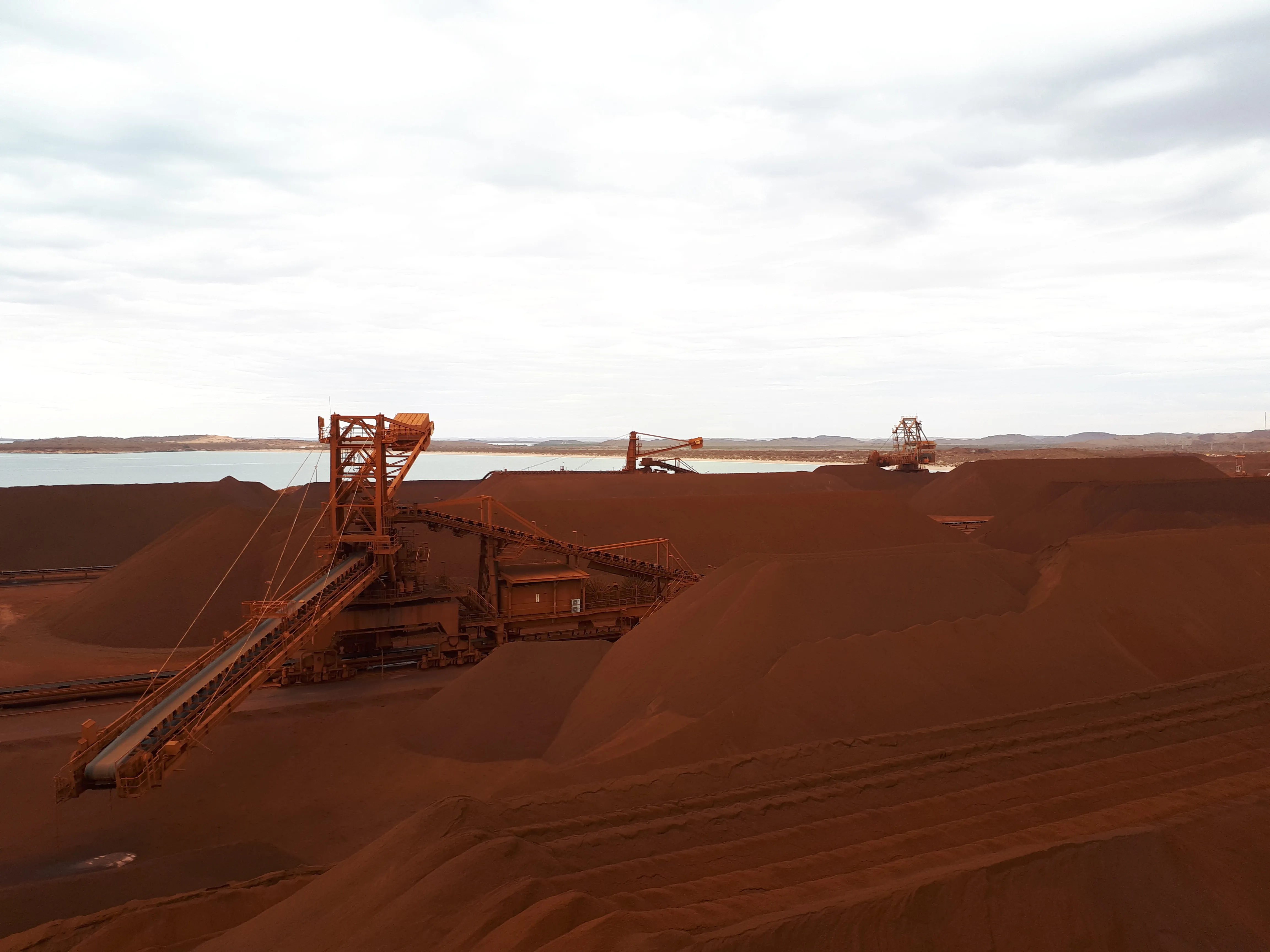
A Tier 1 iron ore producer was expanding operations at an existing port facility to handle a higher-density ore product. The increased material density raised design loads for the facility’s mobile machines originally designed and built to an earlier revision of the governing Australian standard for continuous bulk handling equipment.
The client needed to confirm whether the existing machines could safely operate under the increased loading, identify any structural non-conformances, and develop engineered upgrade solutions where required. The assessment had to address strength, buckling, fatigue, and stability across the full machine structure — portal, slew deck, boom, boom head, and long travel assembly — while also benchmarking the machines against the current editions of AS 4324.1 and AS 4100.
Nominal machine throughput was unchanged; the challenge was purely the increased material density and its effect on structural design loads.
Approach
Igneum led the structural assessment and upgrade design for the bucket wheel reclaimers, combining detailed finite element analysis with code-based assessment and practical modification design.
Structural Assessment
The assessment scope covered strength, buckling, fatigue, and stability for all major structural assemblies. Design loads were recalculated to reflect the higher-density ore in accordance with AS 4324.1:2017, with load combinations developed for the full range of operating, non-operating, and extreme event scenarios.
Where the machines had originally been designed to AS 4324.1:1995, the assessment was conducted against the current AS 4324.1:2017 and AS 4100:2020, as required by the current standard for assessment of existing machines undergoing modification.
Finite Element Analysis
Detailed finite element models of the portal, slew deck, boom, boom head, and long travel assembly were developed and analysed under the revised load combinations. Linear elastic analysis identified areas where member stresses and connection forces exceeded code allowable limits under the increased loading.
Where linear analysis indicated non-conformance, non-linear simulation was used to evaluate actual structural behaviour more accurately — accounting for material yielding, geometric non-linearity, and load redistribution. This advanced analysis demonstrated that many apparent non-conformances were in fact compliant when assessed using more rigorous methods, avoiding unnecessary modifications.
For fatigue, nominal stress analysis was performed at critical welded details throughout the structure. Fatigue damage was assessed against the design load spectra specified by AS 4324.1, with results categorised by criticality to prioritise upgrade actions.
Categorised Risk Assessment
A key aspect of the assessment was the structured categorisation of every identified non-conformance into one of four groups: upgrades required to handle the higher-density ore, potential future upgrades for fatigue life improvement, items deemed conformant through advanced analysis, and items accepted as non-compliant with appropriate risk management measures.
Each non-conformance was assigned a criticality rating and a recommended action — ranging from immediate structural strengthening through to condition monitoring and inspection regime adjustments. This framework gave the client a clear, risk-ranked basis for investment and maintenance planning.
Upgrade Design
For non-conformances requiring structural modification, Igneum designed a package of upgrades including localised box-section reinforcement at the portal, stiffener additions to address buckling in the portal neck area, boom chord strengthening by boxing out the top chord main girders, slew deck reinforcement at the front compartment, and replacement of undersized diagonal members. Where fatigue was the governing concern, solutions included weld improvement techniques, new borescope inspection ports for ongoing condition monitoring, and designed strengthening details held as ready-to-deploy work packs for future implementation if inspection warranted it.
All modifications were designed for installation during scheduled maintenance shutdowns.
Outcomes
- Comprehensive structural assessment of the reclaimer completed across strength, buckling, fatigue, and stability — benchmarked against current AS 4324.1:2017 and AS 4100:2020
- Non-linear FEA resolved a significant number of apparent non-conformances without physical modification, reducing the scope and cost of required upgrades
- A categorised, risk-ranked register of all structural non-conformances provided the client with a clear framework for prioritising capital investment and maintenance actions
- Engineered upgrade solutions were delivered with detailed drawings and installation procedures, ready for execution during planned shutdowns
- Fatigue-critical locations were addressed through a combination of structural strengthening, weld improvement techniques, and enhanced inspection regimes — with pre-designed work packs available for future deployment as needed
- The assessment enabled the client to expand the operational capacity of the reclaimers to accommodate the new ore product, bridging the gap to their planned replacement at end of economic design life
Related services
Ready to discuss your next project?
Whether you need a full engineering assessment, specialist analysis, or an independent technical review — we're here to help. Get in touch to discuss how Igneum can support your operation.