
Reclaimer End of Life Assessment
Challenge
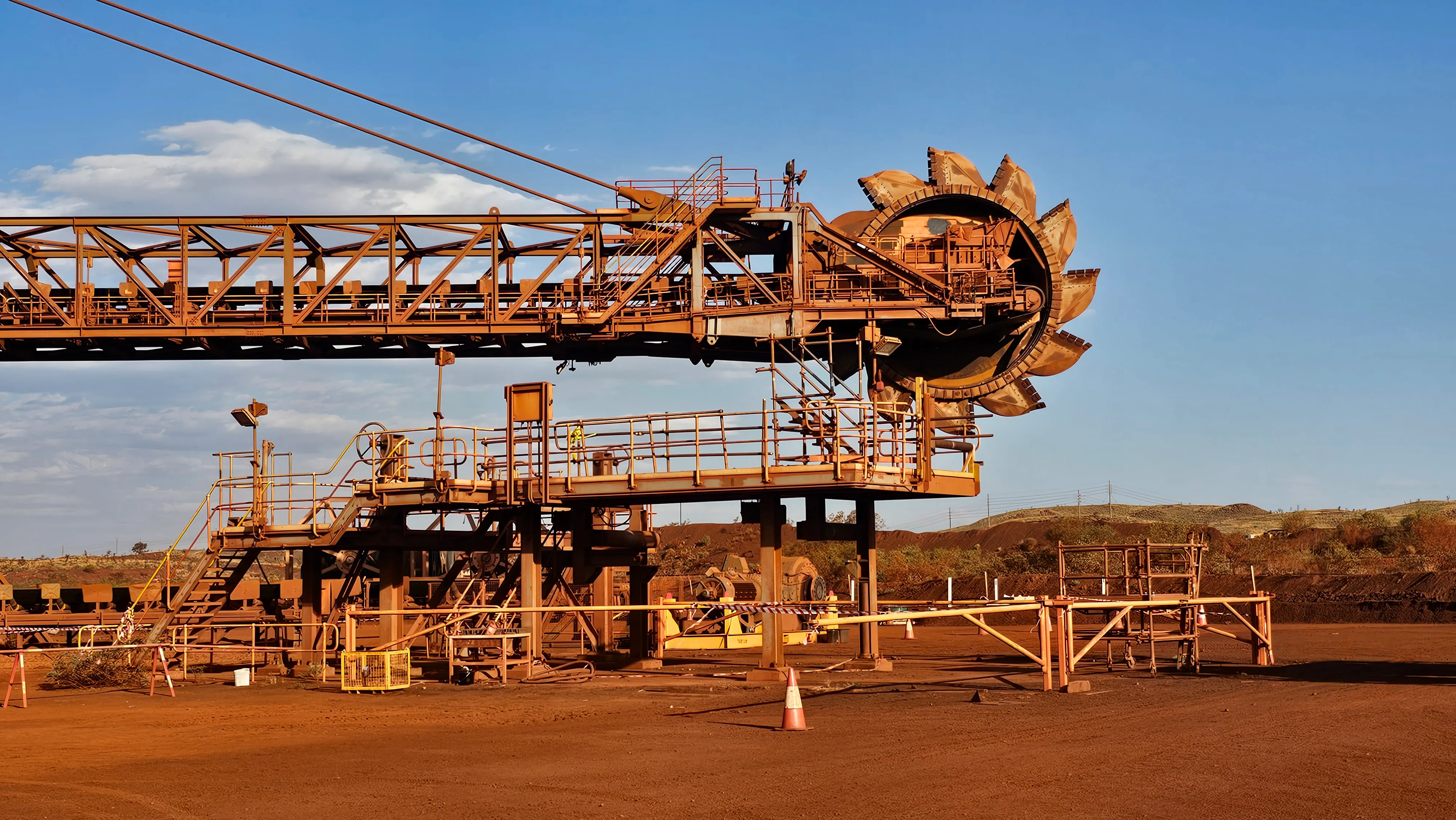
A Tier 1 iron ore producer needed to determine the remaining economic life of a bucket wheel reclaimer that had been in continuous service since 2004. Originally designed for a 25-year operational lifespan, the machine had reclaimed over 550 million tonnes and was approaching a period of planned production ramp-down through to mine closure.
The client faced a critical capital decision: invest in a replacement machine, undertake a major refurbishment, or continue operating the existing asset with targeted maintenance. With replacement costs in the tens of millions and mine closure on the horizon, the commercial stakes were significant. Any decision needed to be underpinned by a rigorous engineering assessment of the machine’s structural condition, compliance status, and the true cost trajectory of continued operation.
Beyond the capital decision, the client needed a clear picture of the machine’s current condition to inform targeted maintenance planning and critical spare requirements for the remaining operational period.
Approach
Igneum conducted a comprehensive end-of-life assessment encompassing operational data analysis, structural evaluation, compliance checking, and economic modelling.
Operational Data Analysis
Ten months of historical operating data was extracted and analysed using Igneum’s FleetBulk data analytics platform. This analysis characterised the machine’s actual loading environment — including throughput distribution, slew patterns, digging resistance spectra, and inertial loads — to replace the generic design assumptions from the original specification with measured values.
The data analysis revealed that the machine was regularly exceeding its design speed limits, with significant recorded instances of travel and slew speeds at more than double the rated values over a statistically significant period. These events presented critical safety and structural integrity risks that had not previously been identified. Additionally, the analysis quantified a significant mass imbalance in the bucket wheel boom, equivalent to an additional 13.5 tonnes at the bucket wheel centre above the original design assumption.
Structural Assessment
A detailed finite element analysis was performed across the full machine structure — long travel, portal, slew deck, bucket wheel boom, rocker, and counterweight boom — under revised load combinations reflecting the actual operating conditions. Both strength and buckling analyses were conducted in accordance with AS 4324.1 and the client’s specifications.
The assessment identified several areas of non-compliance with current standards, including inadequate buckling resistance in the portal structure under upset load conditions, non-conformant boom top chord sections attributable in part to the increased boom mass, and a suspension rope safety factor below the minimum requirement.
Fatigue Life Assessment
Fatigue analysis was performed at over 50 critical weld details across the structure, using the refined load spectra derived from operating data. The analysis modelled fatigue damage accumulation over the machine’s full operational history and projected future damage growth under multiple production scenarios — continued full-rate operation, planned ramp-down, and extended operation beyond the original design life.
This work established the expected timing and cost of fatigue-related maintenance under each scenario, showing that while the machine currently had acceptable fatigue life, multiple areas exhibited accelerated damage that would drive increasing maintenance costs with age.
Economic Modelling
The structural and fatigue results were integrated into an economic model comparing the total cost of ownership across three strategies: replacement with a new machine, major refurbishment, and continued operation with targeted upgrades. The model accounted for capital expenditure, ongoing maintenance costs, projected unplanned downtime, and lost production value over the remaining mine life.
Outcomes
- The assessment demonstrated that continued operation of the existing machine was the most economic strategy given the planned production ramp-down, avoiding tens of millions in replacement capital expenditure
- Critical safety risks were identified and prioritised, including a control system fault which had been incorrectly reporting travel speeds, resulting in the unusually high values detected
- A structured program of targeted upgrades was recommended to address structural non-compliances, including portal reinforcement, machine rebalancing through additional counterweight, and suspension system review
- Fatigue-critical weld details were mapped and prioritised, enabling the client to implement a risk-based inspection program focused on the areas of highest damage accumulation
- The data-driven approach replaced conservative design assumptions with measured values, providing the client with significantly higher confidence in the remaining life projections than a conventional assessment would deliver
- The assessment and its recommendations were delivered in a format accessible to both technical and commercial stakeholders, directly supporting the client’s capital planning process
Related services
Ready to discuss your next project?
Whether you need a full engineering assessment, specialist analysis, or an independent technical review — we're here to help. Get in touch to discuss how Igneum can support your operation.